
Most people who search for a BSc degree in animation are asking one thing: will I actually learn to animate, or will I just sit through theory? With Moople’s four-year programme, practical work is built into the structure. You draw first, then model, texture, rig, light, render and animate. You finish by directing a short film and assembling a portfolio. This guide explains how that works, semester by semester, so you can judge any animation degree on the same terms.
The Short Answer: Practice Runs Through All Eight Semesters
The BSc in Animation Film Making at Moople Institute runs for four years, split into eight six-month semesters. It is affiliated to MAKAUT, in association with the Institute of Management Study and Dr. B.C. Roy Academy of Professional Courses. Full-time and weekend formats are both available.
The structure is simple: fundamentals first, software second, production last. Each semester adds a layer, so by the time you reach character acting you already know how to build the character.
Semester-by-Semester: What You Actually Work On
| Stage | Focus | Software |
| Semester 1 | Drawing, visual design | Adobe Illustrator |
| Semester 2 | Graphic design, audio and video editing, digital branding | Photoshop, Premiere |
| Semester 3 | CG modelling, texturing | Maya, Photoshop, Substance Painter |
| Semester 4 | Lighting, rendering, rigging, props and character animation | Maya, Arnold, After Effects |
| Semester 5 | Human locomotion, body mechanics | Maya |
| Semester 6 | Acting for animators, advanced character animation, portfolio making | Maya, Arnold, Premiere, After Effects |
| Semester 7 | Filmmaking basics, animation short film project, research methodology | Maya, Premiere |
| Semester 8 | Human motion | Maya |
Years 1 and 2: Learning to See Before You Animate
Drawing and visual design in the first semester can feel slow if you came for 3D. They matter anyway. Animators who can’t read shape, weight and silhouette produce stiff movement, however good their software skills are.
By semester 3 you are in Maya, building 3D models and texturing them. Semester 4 is where it starts to feel like production: you rig a character so it can move, light a scene, render it with Arnold, and animate props and simple characters.
Year 3: Where Animation Becomes Performance
Human locomotion and body mechanics are the hardest parts of the course. Walk cycles, weight shifts, jumps and lifts look easy until you try to animate them. Expect repetition, critique and reworking the same shot several times. That repetition is the training.
Semester 6 adds acting for animators, which teaches you to make a character think and react rather than just move. It also includes portfolio making, so you start assembling your showreel before the course ends.
Year 4: The Short Film
Semester 7 centres on an animation short film project alongside an introduction to filmmaking. This is the closest classroom equivalent to a real production. You plan, model, animate, edit and deliver something finished. A completed short tells a recruiter far more than a list of software you’ve used.
Why the Software Stack Matters
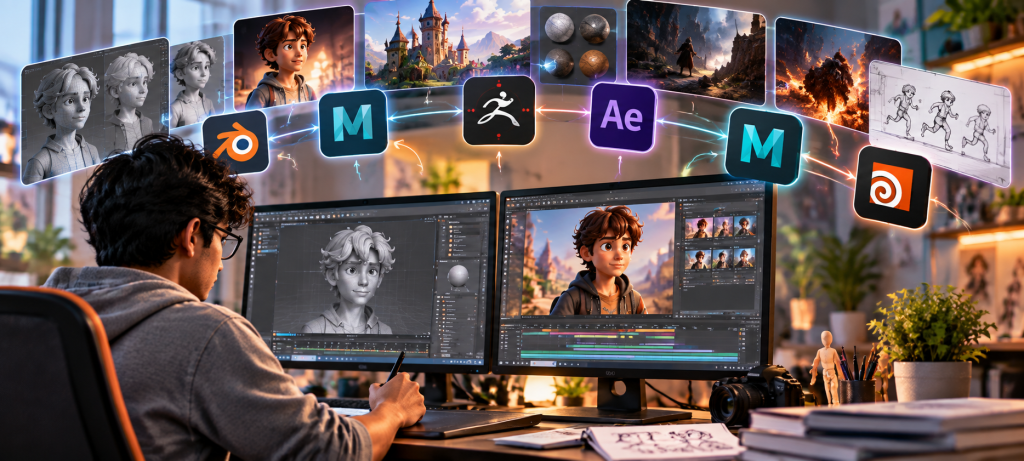
Maya, Arnold, Substance Painter, Photoshop, Premiere and After Effects are tools used in professional pipelines. Learning them in sequence also means you understand how work moves between departments, which helps when you join a studio team or freelance.
Moople’s course page also describes the curriculum as AI-integrated. Ask your counsellor exactly where and how, so you know what that means in the classroom.
How to Get More Out of the Practical Sessions
- Keep every exercise. Old walk cycles and early models show your progress and can become portfolio material.
- Study reference footage. Record yourself or someone else doing the movement you’re animating.
- Ask for critique early. Faculty feedback on a rough blocking pass saves hours of polishing the wrong thing.
- Practise outside class. Even 30 focused minutes of animation exercises a day builds speed.
- Build the portfolio from semester 3 onwards, not in the final months.
Who Teaches You Matters
The faculty listed on Moople’s BSc in Animation page are described as working professionals. Their stated experience ranges from 9 to 20 years in 3D animation. Practitioners tend to teach the shortcuts, common mistakes and studio expectations that textbooks leave out. Moople is also listed as an affiliated training partner of the National Film Development Corporation of India.
👉Explore More: Top Facilities to Look for in BSc Animation Colleges in 2026
Visiting a Centre: What to Ask
Moople runs centres across Kolkata and nearby areas, including Chowringhee, Jodhpur Park, New Alipore, Sealdah, Baguiati, Barasat, Sonarpur, Serampore, Chandannagar and Berhampore. Whichever you visit, ask these:
- Can I see student work from the semester I’d be joining?
- What does the lab setup look like, and how much hands-on time do students get?
- Is the BSc in Animation available at this particular branch, in full-time or weekend format?
- How is the final short film project organised?
- What does placement guidance involve in practice?
Fees vary by location and timing, and scholarships are available for eligible students. Confirm current figures directly with the centre.
BSc vs. a Diploma in Animation

A diploma such as Moople’s 3D Animation or 2D Animation course is shorter and tool-focused. A BSc degree in animation takes four years and adds a university-recognised qualification, design fundamentals, filmmaking and research. If you want a degree plus a portfolio, the BSc fits. If you want to enter the industry quickly with one skill, a diploma may suit you better.
Frequently Asked Questions
According to Moople’s course page, you need to pass Class 12 with 50% aggregate marks.
Four years, or eight semesters of six months each.
Yes. Moople offers both full-time and weekend formats. Check which one your preferred branch runs.
No. The first semester covers drawing and visual design from the basics.
Illustrator, Photoshop, Premiere, Maya, Substance Painter, Arnold and After Effects across the eight semesters.
Roles include 3D animator, character animator, game animator, 3D modeller and visualisation artist, across film, games, architecture, advertising and e-learning. Moople offers placement guidance, but getting hired depends on your portfolio and interview performance.
Self-learning works if you are disciplined. A structured degree adds mentoring, deadlines, peer feedback and a recognised qualification.
Conclusion
Practical training in a BSc degree in animation is not one workshop. It is a build-up: drawing, modelling, rigging, performance and finally a short film. The strongest courses make you produce work in every semester, and you should judge any programme by how much finished work its students show you.
If you’re in Kolkata or the surrounding areas and want to see how this works in a real classroom, explore the BSc in Animation course at Moople Institute and book a counselling session at your nearest centre.


Leave a Reply